info@labolsadepapel.com

Climate change cannot be tackled through a single solution.
We need to reduce emissions, protect ecosystems that capture carbon, reduce our dependence on fossil resources, use materials more efficiently and prevent them from losing their value after a single use.
The contribution of the paper bag must be understood within this broader system.
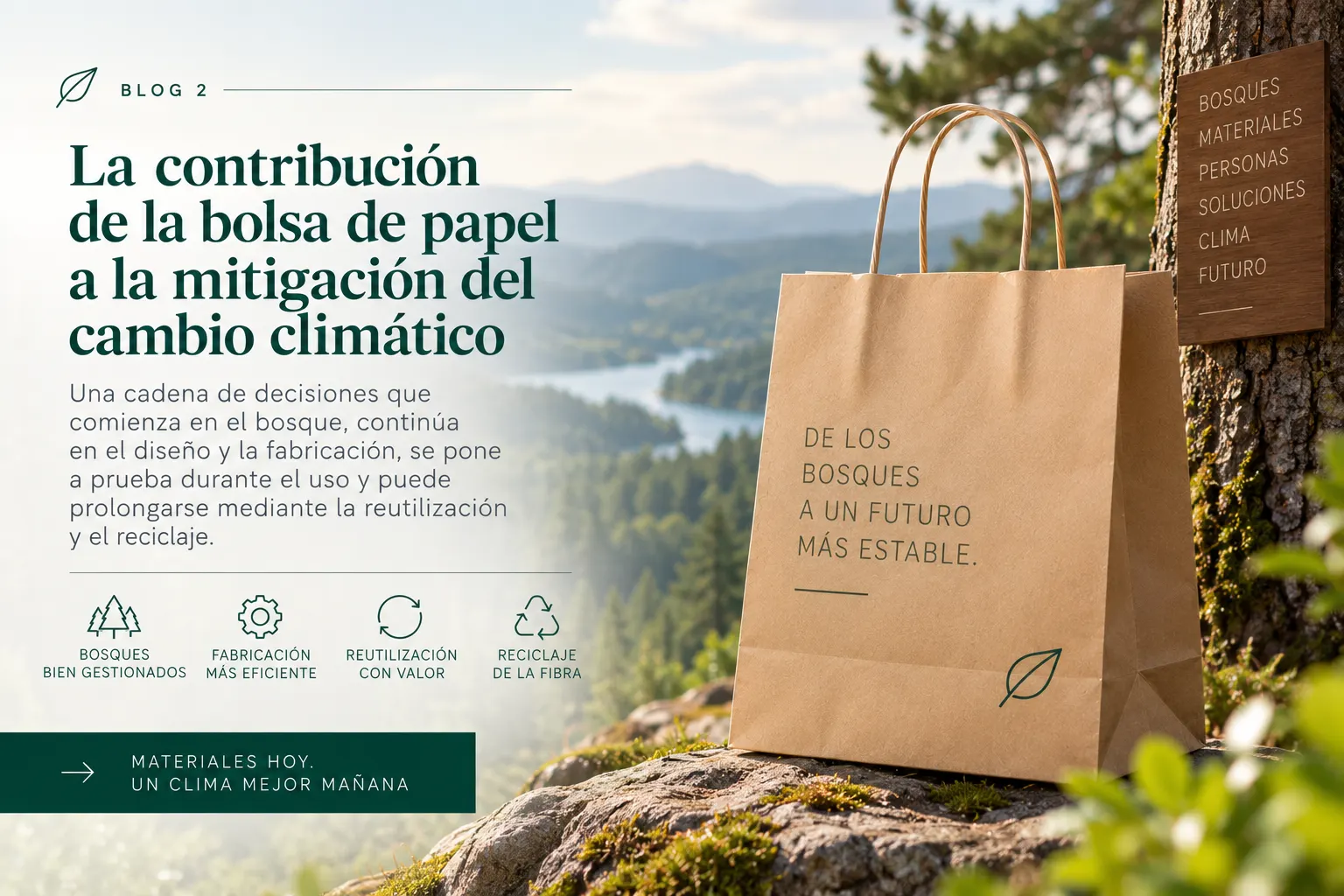
It is neither impact-free nor a solution capable of stopping global warming on its own. Its climate contribution results from a chain of decisions that begins in the forest, continues through design and manufacturing, is put to the test during use and can be extended through reuse and recycling.
It all begins in a well-managed forest
Trees absorb carbon dioxide from the atmosphere as they grow and store carbon in the wood. For this reason, forests play an essential role in regulating the climate.
But it is not enough for a material simply to come from a tree.
Its climate contribution depends on forest conservation, continued growth and regeneration, and on management that balances timber harvesting with the protection of biodiversity, soil and water, as well as resilience in the face of wildfires, droughts and disease.
The European Environment Agency points out that forests are major carbon reservoirs and that wood-based products, their sustainable use and the cascading use of biomass can form part of climate change mitigation strategies.
This is why fibre traceability and responsible forest management are so important. Renewable origin must not be merely a characteristic of the material. It must be supported by a system that ensures the continuity and protection of the resource from which it comes.
From tree to bag
When wood is transformed into paper, some of the carbon captured during the tree’s growth remains stored in the cellulose fibres.
European climate legislation expressly includes paper among harvested wood products that contain carbon. That carbon is not stored forever: at the end of the product’s life, it may return to the atmosphere, depending on how the product is treated. The paper bag should not, therefore, be presented as a permanent carbon store, but as part of a renewable biological cycle.
This distinction matters.
The main raw material used to make a paper bag comes from carbon that was previously in the atmosphere and was captured through plant growth. It does not originate from the extraction of a fossil polymer accumulated beneath the Earth’s surface over millions of years.
That does not make the bag an emissions-free product. Producing paper, converting it, printing it and transporting it require energy and involve the use of other materials. Its climate contribution also depends on how all these processes are carried out.
Manufacturing better is also mitigation
A bag does not become better simply because it is made of paper if it uses more material than necessary.
Efficiency begins with design.
Choosing the appropriate paper weight, adapting the dimensions to the product it needs to carry, improving strength, reducing production waste, optimising manufacturing processes and avoiding components that hinder recycling make it possible to perform the same function while using resources more intelligently.
The new European packaging policy is moving precisely in this direction: less waste, lighter packaging, greater recyclability and the removal of unnecessary elements.
The best bag is not the one that contains the most material, but the one that uses the amount needed to perform its function properly.
A useful bag can be used again
Reuse is not exclusive to any particular material.
A sufficiently strong paper bag can be used again to carry another purchase, store objects or meet different everyday needs.
Every additional use makes better use of the resources and energy invested in its manufacture.
Life-cycle studies must be interpreted with caution because their results depend on the bag’s design, weight, production process, transport, number of uses and end-of-life treatment. The United Nations Environment Programme stresses that no alternative is automatically more sustainable simply because it is made from a different material, and that reuse is one of the most effective ways of reducing the impact associated with each use.
The paper bag does not need to claim that it always outperforms every other solution across all environmental impact categories.
Its case is more robust: it can perform its function using a renewable raw material, be used again while it retains its performance and then be recycled so that its fibres can be recovered.
Recycling allows the fibre to continue
When a paper bag reaches the end of its useful life and is correctly placed in the collection system, its fibres can be recovered to manufacture new paper products.
Recycling does not erase the impacts that have already occurred, nor does it turn fibre into an infinite resource. But it prevents a useful material from losing its value after a single use and reduces the need to draw continuously on new raw materials.
Spain has an established paper and cardboard collection and recycling system. In 2024, 5.2 million tonnes were recycled, and the overall recycling rate for these materials reached 83.6%. This figure does not refer specifically to paper bags, but it demonstrates the capacity of an infrastructure that can recover their fibres when they are properly separated.
Circularity does not, however, begin at the blue recycling bin.
It begins much earlier: when a recyclable bag is designed, when papers, inks, adhesives and handles are properly selected, when the necessary amount of material is used and when consumers are informed about how to dispose of it correctly.
A contribution that must be demonstrated
It would not be rigorous to claim that every paper bag always has a lower climate footprint than every other alternative.
Comparisons depend on multiple variables and must consider the entire life cycle.
But it would be equally unrigorous to ignore paper’s own contributions: its renewable origin, its integration into the biological carbon cycle, its potential to reduce dependence on fossil raw materials, its reusability and the existence of a widely developed system for recovering its fibres.
The climate contribution of the paper bag does not lie in any magical property.
It results from a forest that is conserved and regenerated, an industry that improves its efficiency, a bag designed to perform its function with the right amount of material, a consumer who reuses it whenever possible and a system that recovers its fibres at the end of its useful life.
Mitigating climate change also means changing the way we obtain, use and recover materials.
Within that process, the paper bag makes a specific, reasonable contribution with the potential to continue improving.