info@labolsadepapel.com

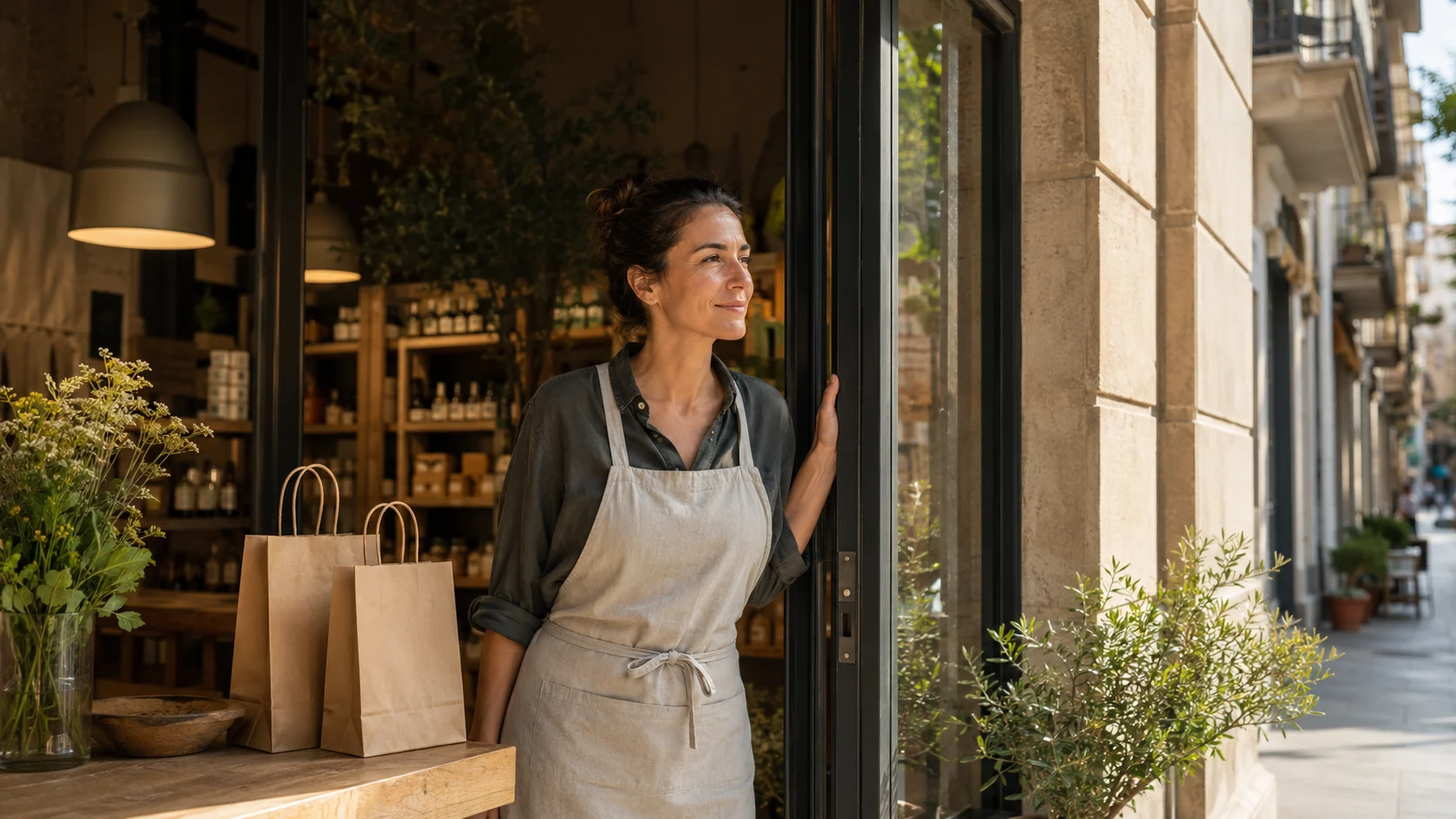
Every morning, while many streets are only beginning to wake, someone raises a shop shutter.
They switch on the lights, prepare the premises, check the orders, arrange the products and get ready to welcome people they may have known for years. This is how the small shop begins each day: with a decision that has to be made all over again.
To open.
Praising small shops does not mean diminishing large retail chains. Both are part of today’s commercial landscape and respond to different needs. Large companies bring breadth of choice, logistical capacity, availability and an organisation capable of serving millions of consumers.
Small shops offer a different kind of value.
Their closeness is not simply a matter of the distance between a shop and our home. It is a way of paying attention. It can be found in remembering what we usually buy, recommending something because our tastes are known, letting us know that something we were waiting for has arrived, or asking after a member of our family.
At that moment, we cease to be merely someone who walks in, buys and pays.
We become someone who is recognised.
That relationship is built slowly. It grows out of many brief conversations, repeated visits, small gestures and shared memories. None of these moments seems extraordinary when considered on its own. Together, however, they create something that is difficult to reproduce: trust.
Behind that trust lies a great deal of work.
Small retailers do far more than serve the public. They select products, speak to suppliers, organise stock, resolve problems, control costs, prepare window displays, learn new tools and look for ways to remain relevant to customers whose habits are constantly changing.
Their working day is filled with invisible tasks. Some begin before the first customer arrives; others continue after the doors have closed.
That is why, when we speak of their resilience, we should not imagine a passive form of survival. Their resilience has consisted, above all, in learning how to change.
Many shops have introduced online ordering, home delivery, new payment methods, social media, different products and packaging solutions that are better suited to current expectations. They have evolved without giving up what gives their work its meaning: a direct relationship with the people they serve.
The small shop has not made it this far by standing still. It has done so by adapting again and again.
Nor should we idealise it. Not every independent shop necessarily offers a close and personal service, just as not every large chain is impersonal. Human warmth is not guaranteed by the size of a business.
But a smaller scale creates conditions that are especially favourable to closeness.
The person making the decisions is usually very close to the person serving the customer. Sometimes they are one and the same. This makes it possible to listen, respond quickly, adapt the offer and better understand what is happening on the other side of the counter.
It also allows each establishment to retain a personality of its own.
The streets of a town or city are not distinguished only by their buildings. They are also shaped by their bookshops, bakeries, pharmacies, haberdasheries, food shops, florists, fashion boutiques and specialist retailers. Each one brings its own light, its own window display, its own way of welcoming people and another reason to walk down that street.
When they disappear, the town loses more than a place to buy something.
It loses diversity. It loses conversation. It loses places where people can still recognise one another.
Within this relationship, even the simplest objects acquire meaning. A bag is not merely the packaging used to carry a purchase. It is also part of the gesture through which a shop hands over something it has prepared for its customer.
The paper bag quietly accompanies that moment. It protects the purchase, carries the identity of the establishment, goes out into the street and extends the shop’s presence beyond its doors.
For a small retailer, that bag may be one of its most visible means of communication. Above all, however, it can be the final expression of work carried out with care: the way in which the shop places in the customer’s hands what they have just chosen.
The small shop does not belong to the past. It represents a form of retail that will remain necessary for as long as people value being listened to, looked after and recognised.
Every shutter that is raised is a small declaration of confidence in the street, the neighbourhood and the future.
That is why the small shop deserves our praise.
Not simply because it is small, but because it makes room for something greater—something we should never lose: people encountering one another.