







The circular bioeconomy is gaining new prominence in Europe. What for years was primarily presented as a sustainability model has also become an industrial and economic strategy focused on making better use of resources. Paper bags are part of this transformation.
When we talk about the circular bioeconomy, we are referring to a way of producing and consuming that uses biological resources, seeks to ensure their renewal and aims to keep them in circulation for as long as possible.
This concept goes far beyond manufacturing products from natural materials. It encompasses resource management, industrial activity, technological innovation, the use of by-products and the recovery of materials after use.
Paper bags are a good example of how this model works, as they are part of a value chain that brings together many of these activities.
Europe embraces a new resource-based economy
On 27 November 2025, the European Commission presented its new Strategy for a Competitive and Sustainable Bioeconomy.
Its aim is to promote the development of economic activities based on biological resources, strengthen Europe’s industrial capacity and encourage a more efficient and circular use of raw materials.
The strategy includes investment in innovation, the development of markets for bio-based materials and the sustainable management of natural resources.
This is far from being a marginal economic activity. According to the European Commission, the bioeconomy accounts for approximately 5% of the European Union’s GDP and employs more than 17 million people.
These figures help illustrate the scale of a transformation affecting sectors as diverse as agriculture, forestry, the food industry, chemicals, textiles and the paper industry.
Europe thus recognises that moving towards a more sustainable economy also requires a productive base capable of transforming biological resources into materials and products that are useful to society.
The paper industry has been working with this model for decades
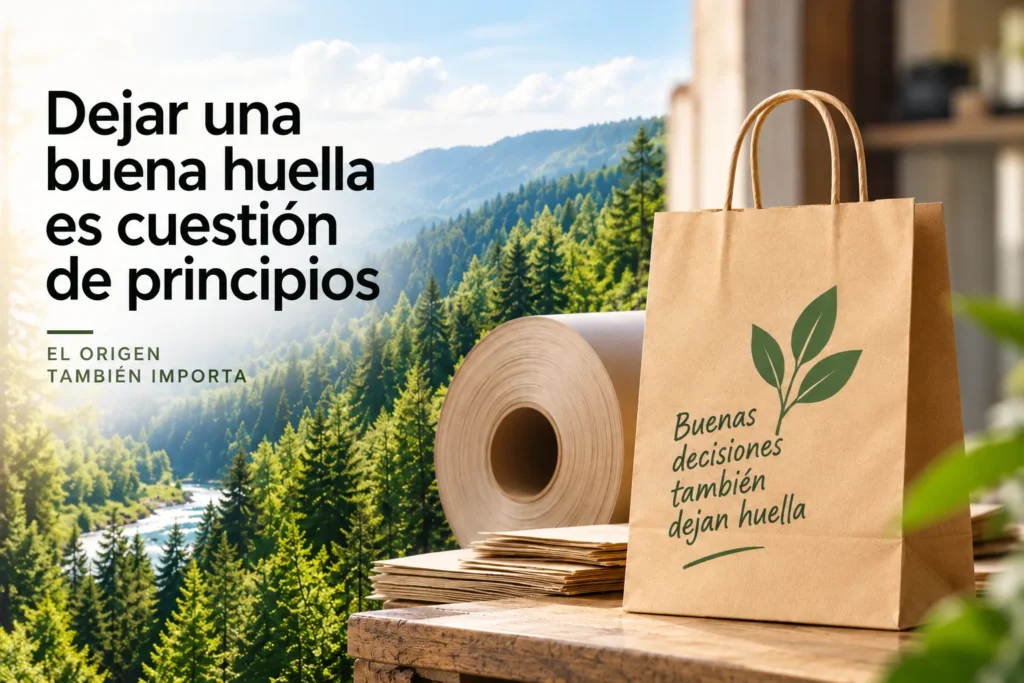
The paper industry is one of the most established examples of the industrial use of renewable biological resources.
Its main raw material is cellulose fibre, obtained from wood and recovered paper. Paper manufacturing transforms this fibre into a material that can be used in numerous applications and, after use, can be recovered and reintroduced into production processes.
Paper bags are part of this industrial activity.
Behind them lies a chain of companies and professionals involved in forest management, pulp and paper production, bag manufacturing, the development of machinery, inks and adhesives, and recovery and recycling activities.
Each of these activities helps transform a biological raw material into a product intended for retail use and subsequently facilitates the recovery and reuse of its fibres.
The circular bioeconomy allows us to consider this entire activity rather than focusing solely on the product that reaches the consumer.
Renewable does not mean unlimited
One of the fundamental principles of the circular bioeconomy is that the renewable origin of a material must be accompanied by responsible resource management.
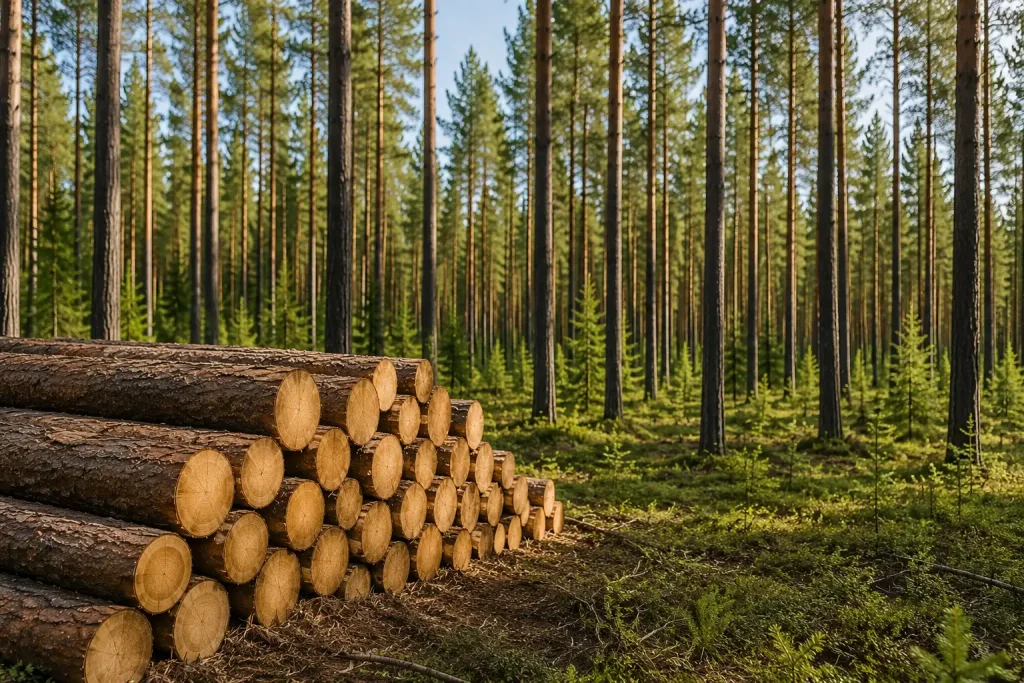
Wood can be renewed through tree growth, but this capacity for renewal requires protecting forest ecosystems, preserving biodiversity and using resources in ways that are compatible with their conservation.
This is why sustainable forest management, raw material traceability and certification systems are becoming increasingly important.
Efficient resource use is equally important. The circular bioeconomy seeks to obtain the greatest possible value from raw materials and make use of by-products and recovered materials to avoid unnecessary losses.
In the paper sector, this approach translates into improving manufacturing processes, optimising fibre use and facilitating its recovery at the end of a product’s useful life.
Sustainability also requires industry and innovation
The transition towards a circular bioeconomy does not depend solely on the availability of renewable raw materials.
It requires companies capable of processing them, industrial facilities, technical expertise and continuous investment.
In paper bag manufacturing, innovation is reflected in the development of papers with properties suited to each application, the optimisation of materials and production technologies designed to improve efficiency.
It is also reflected in the design of products that can be used for longer periods and that facilitate the subsequent recovery of their materials.
All of this forms part of an industrial transformation that must combine sustainability, functionality and competitiveness.
It is precisely this combination that features prominently in the new European strategy: developing an economy that makes better use of its biological resources while strengthening its industrial base.
Paper bags are part of this new economy
Paper bags help bring a far-reaching economic concept closer to a product found every day in thousands of retail establishments.
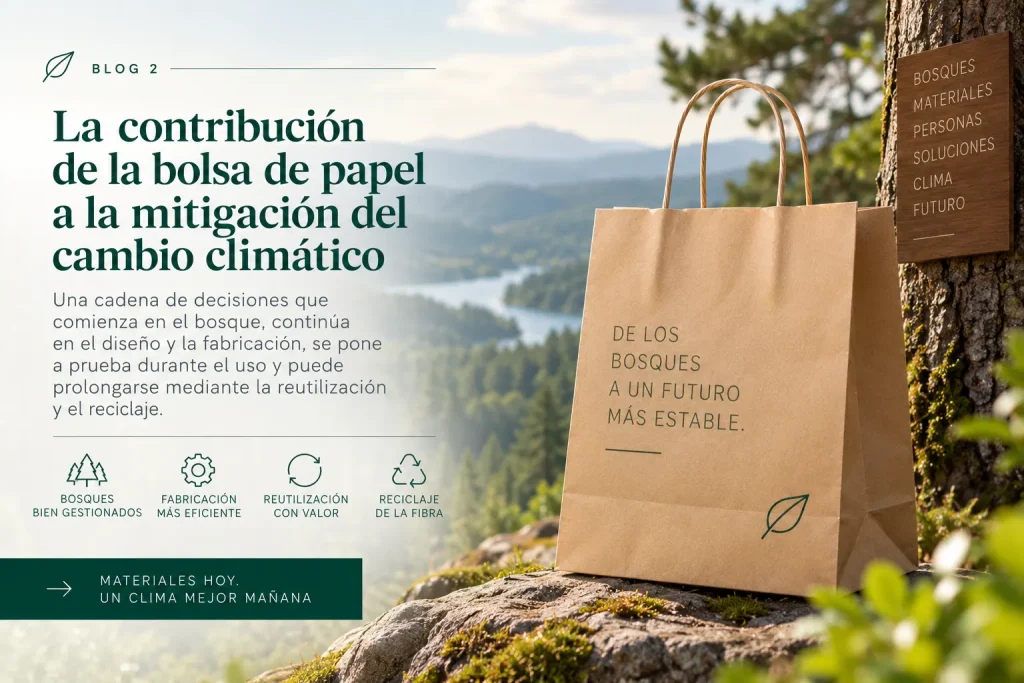
Their origin in a renewable raw material, their manufacture through a specialised industrial value chain and the possibility of reusing them and recovering their fibres after use reflect different dimensions of the circular bioeconomy.
However, their contribution should not be regarded as an automatic quality or a generic environmental claim. It depends on how resources are obtained, how the material is processed, how the product is used and what happens to its fibres at the end of its useful life.
Talking about the circular bioeconomy therefore also means talking about responsibility, innovation and continuous improvement.
Paper bags do not need to wait for the circular bioeconomy to arrive. They are already part of it. The challenge is to continue developing the full potential of this model and to demonstrate, through facts, the value it brings to our society.